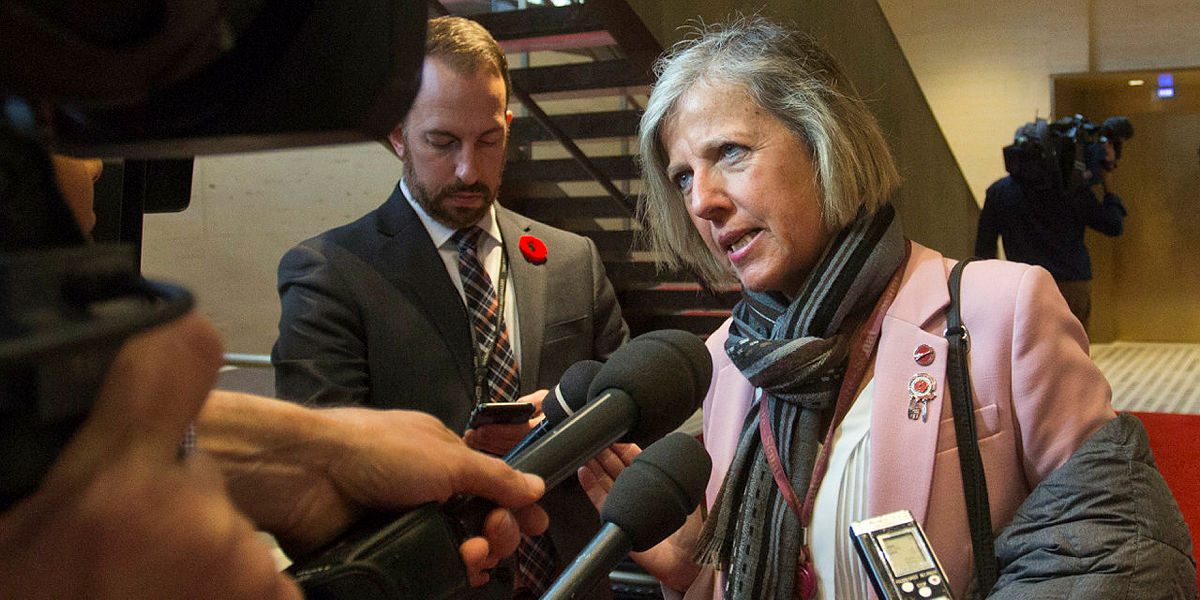
Sen. Marty Deacon speaks with reporters outside the Senate Chambers before the annual ceremony of Remembrance in the Senate to kick off Veterans' Week on Nov. 04, 2019.
Push for national ban on sports betting ads gains momentum among MPs
Regulatory | |October 30, 2026
A proposal to ban sports betting advertisements is picking up steam on Parliament Hill.
For years, Ontario Sen. Marty Deacon has sought to curtail the number of gambling ads shown to Canadians during broadcasts of hockey games, football matches, and other sporting events. Bill S-211, introduced in the Senate last year, would create a national framework for regulating sports betting ads across Canada — but Deacon has her sights set on a more concrete measure.
“If I had all the power and all the stars aligned, I’d love a full ban on advertising [for sports betting companies],” Deacon said during an appearance before the House Canadian heritage committee on Thursday. “End of story.”
Deacon and Liberal MP Bardish Chagger (Waterloo, Ont.), the bill’s sponsor in the House of Commons, believe sports betting has become an epidemic, especially for young Canadians, many of whom have become addicted and are suffering from knock-on financial and mental health consequences.
The pair of parliamentarians have suggested tackling the pervasiveness of gambling ads is one way to address what they describe as a burgeoning public health crisis.
“As Canada opens up to wider prediction markets like we see with Kalshi and Polymarket in the U.S., we are making the conditions perfect for a nation of problem gamblers,” said Deacon.
“For many Canadian youth, they cannot turn on the TV, open their phones, take a bus, watch or even play the sports they love at their local fields and arenas without encountering some form of gambling promotion.”
Recent analysis from the CBC found 3,000 gambling messages were displayed over the course of seven televised Stanley Cup playoff games earlier this year, while 95 per cent of the ads contained no information about age restrictions or possible harms.
Additionally, a report from Mental Health Research Canada suggests approximately 70 per cent of Canadians gamble, while the number of gambling-related illnesses and suicides continues to rise.
Although a ban on sports betting ads is not explicitly outlined in Bill S-211, the idea is gaining momentum among MPs of various political stripes.
“I do appreciate what the senator is trying to do,” Conservative MP Ned Kuruc (Hamilton East—Stoney Creek, Ont.) told The Wire Report. “They made some strong arguments comparing [gambling] to cannabis, alcohol, and cigarettes.”
“So, I do agree with that [and] I would support it.”
Alcohol advertisements are allowed in Canada, though they face heavy regulations from the CRTC, while cigarettes and cannabis ads are prohibited under the Tobacco and Vaping Products Act and Cannabis Act, respectively.
“Parliament is strongly justified in acting in the face of this,” said Renze Nauta, who headed policy for ex-Conservative leaders Andrew Scheer and Erin O’Toole and now works at the think tank Cardus. “I would point to the precedent.”
“I generally do not favour government interference in markets, but we must acknowledge this is a market of a different type, where the data shows the product is becoming dangerous, especially to young people.”
Nauta, who also appeared before the heritage committee, recommended amendments to the bill that would “completely” ban sports betting advertisements or, at least, during game broadcasts.
Liberals want ‘conversation’ on total ban
Two Liberal MPs stopped short of endorsing a total ban, but emphasized the importance of having a conversation that could lead to advertising restrictions.
“I think the conversation has to happen,” MP Fares Al Soud (Mississauga Centre, Ont.) told The Wire Report.
“And once that conversation happens, and we pull in all the relevant entities, including the gambling associations and the gaming associations, we can start to establish where the deficits are.”
Liberal MP Lisa Hepfner, who also chairs the committee, said she empathized with Canadian sports fans who are constantly being “bombarded” with gambling ads.
“I’m absolutely open to the conversation,” she said when asked about the idea of a full ban. “It’s a problem and I think it has just become too much.”
Meanwhile, NDP MP Gord Johns (Courtenay—Alberni, B.C.) posted a statement on social media that said the number of gambling advertisements is “out of control.”
“As the NDP critic on health and mental health, I believe that gambling addiction is a serious public health issue,” wrote Johns. “It can devastate families, undermine mental health and push people into financial hardship. We shouldn’t be encouraging harmful behaviour every time Canadians turn on a hockey game.”
“It’s time to put public health, especially the well-being of our kids, ahead of gambling industry profits.”
S-211 faces opposition from Bloc, broadcasters
Support for Deacon’s proposed legislation is not universal, as Bloc Québécois MP Martin Champoux (Drummond, Que.) argued Bill S-211 infringed upon provincial jurisdiction.
“Advertising, health, gambling, it all comes from Quebec’s jurisdiction,” said Champoux. “Even though it has good intentions and I know it comes from a good place…, but I don’t see anything. I looked for an angle from which we could support this, but there really is nothing.”
“Everything is covered by Quebec or the provinces.”
In 1985, Ottawa reached an agreement with the premiers to place gambling under provincial jurisdiction. Currently, provinces have respective gaming and lottery commissions that govern the industry and regulate relevant advertising.
However, Deacon has said a policy system that allows individual provinces to adopt different rules has created a “patchwork” of regulations.
Following the federal government’s decision to legalize single-game betting in 2021, Ontario became the first province to create a private sector gambling market in 2022, with Alberta following suit earlier this year, while other provinces face pressure to do the same.
“It stopped being provincial [jurisdiction] when Ontario’s online gambling began to seep across Canada,” said Deacon during her committee appearance. “It has led to a situation where each province and territory is quite limited in controlling advertising to their residents.”
Later in the meeting, Kevin Desjardins, who leads the Canadian Association of Broadcasters, said his members acknowledge the importance of protecting vulnerable Canadians from gambling addictions, but emphasized that betting advertisements are already regulated in Canada.
“Our problem is that the bill before you appears to assume that there’s a significant regulatory gap that needs to be addressed, without first establishing that such a gap already exists,” said Desjardins, who added that additional rules could push advertisers to less regulated or offshore platforms.
Bill S-211 reached the committee stage having passed second reading in the House with support from Liberals, New Democrats, Green Leader Elizabeth May (Saanich—Gulf Islands), and a majority of Conservative MPs. It cleared second reading last year, meaning it could become law in the near future.
The heritage committee is scheduled to continue its study of the bill next week, when MPs will conduct clause-by-clause consideration before putting the proposed law to another vote.