
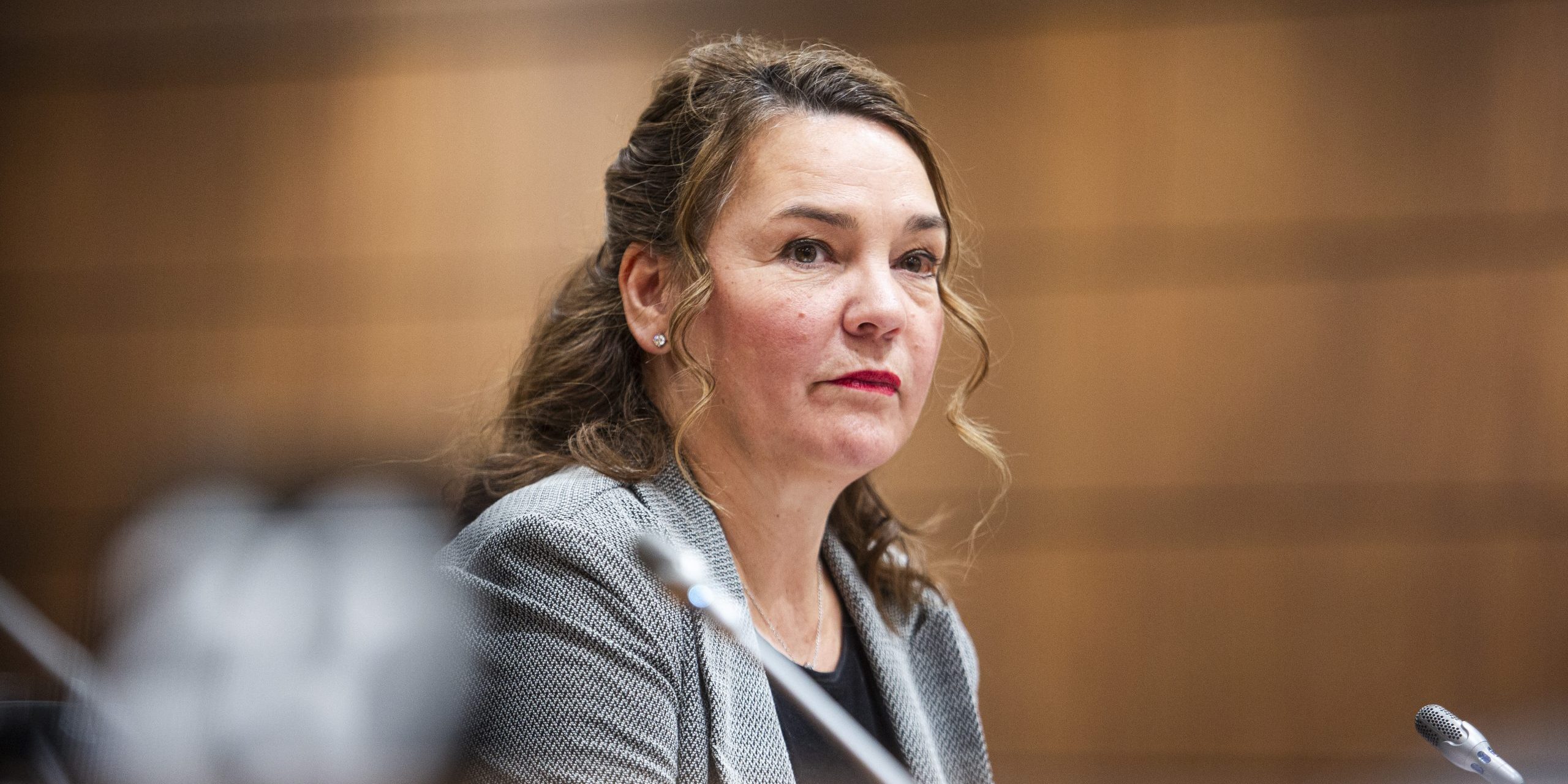
Information Commissioner of Canada Caroline Maynard appears before the House of Commons Standing Committee on Access to Information, Privacy and Ethics on Feb. 9, 2026. The Hill Times photograph by Andrew Meade
Liberals set to update access-to-information law: watchdog
Regulatory | |October 20, 2026
Information Commissioner Caroline Maynard has been informed that Canada’s access-to-information law will be updated in the coming months, though the scope of the changes has not yet been disclosed.
At an event hosted by the International Institute of Communications in Ottawa this week, Maynard faced questions from stakeholders regarding whether the Access to Information Act needs a facelift, to which she said the Liberal government had promised the law would be amended in the near future.
“I’m told that we will see something in December [or] January,” she said. “But we don’t know if there’s going to be actual changes to the act or [just] administrative changes to processes.”
Introduced in 1985, the law governs Canada’s access-to-information regime, which allows members of the public to request documents from the federal government and federal institutions. Per the legislation, Ottawa must review the legislation every five years.
Treasury Board President Shafqat Ali (Brampton—Chinguacousy Park, Ont.) launched the latest review in March, which put forward a discussion paper proposing several legislative changes that, among other things, would allow federal organizations to put access requests “on hold” and remove “transitory records,” like emails and texts, from the law’s scope.
As reported by The Hill Times, the proposals were largely panned by various subject matter experts and members of the opposition, including Conservative MP Stephanie Kusie (Calgary Midnapore, Alta.), who described the potential changes as a “clear step backward for transparency and access to information.”
Meanwhile, the information commissioner’s submission to the federal consultation called for large-scale changes to appropriately resource departments and institutions, therefore improving the government’s ability to respond to information requests in a timely manner.
Maynard’s office also advocated for more proactive disclosure from Ottawa, independent funding for the commissioner’s office, as well as access to cabinet confidences, which are currently exempted under the law.
“I’d like to have access to cabinet confidence information,” Maynard told the crowd at the National Arts Centre on Monday. “Right now, I don’t even see the documents. I see secret, top secret, legal opinions, basically everything but cabinet confidence, and it’s definitely an exclusion of the Act that is being used more and more by our governments.”
“If you don’t have an independent review of those types of documents, citizens will continue to not trust and not understand what decisions are being made.”
Maynard’s comments marked the continuation of a yearslong request from the longtime bureaucrat, who has served as information watchdog since 2018.
The law’s exemption for cabinet documents makes the federal government unique amongst provinces, as well as other commonwealth jurisdictions, like the U.K., Australia, and New Zealand.
The Treasury Board Secretariat’s discussion paper made no references to scoping-in cabinet confidences during any forthcoming legislative update.
Maynard also suggested the legislation is too often exploited by governments looking to withhold information, rather than promoting transparency, as is the policy’s intention.
“Public interest should be part of our Act, so that information is provided unless there is a harm that can be happening to our government,” she said. “It shouldn’t be the opposite.”
“Right now, the Act is used as a shell to not provide information.”
The law’s most recent substantive update came in 2019, which afforded the watchdog’s office with a new authority to issue binding orders under the Act (previously the commissioner could only make recommendations) and eliminated various fees associated with submitting requests.
However, for Maynard, subsequent amendments are more than overdue.
“The exemptions are the same [and] the limitations are the same,” she said. “When you go and review the acts of other countries that are reviewing legislation, they have a lot more modernized legislation than we do in Canada.”
“[So,] there’s lots that can be done, and hopefully this government will actually finally do something.”
When asked by The Wire Report to confirm Maynard’s statement that Ottawa was planning an imminent update to the law, Mohammad Kamal, a spokesperson for Ali, said “access to information is essential for our democracy and must reflect Canadians’ and Indigenous Peoples’ expectations for accessible and trustworthy information..”
“The current review of the Access to Information Act was launched in June 2025, followed by public engagement activities in March 2026,” said Kamal in a statement. “The public engagement phase of the review is now closed.”
“Access to information remains an important component of the Government of Canada’s commitment to transparency and accountability.”
Ali’s office would not respond to questions about the timeline for any legislative update.
