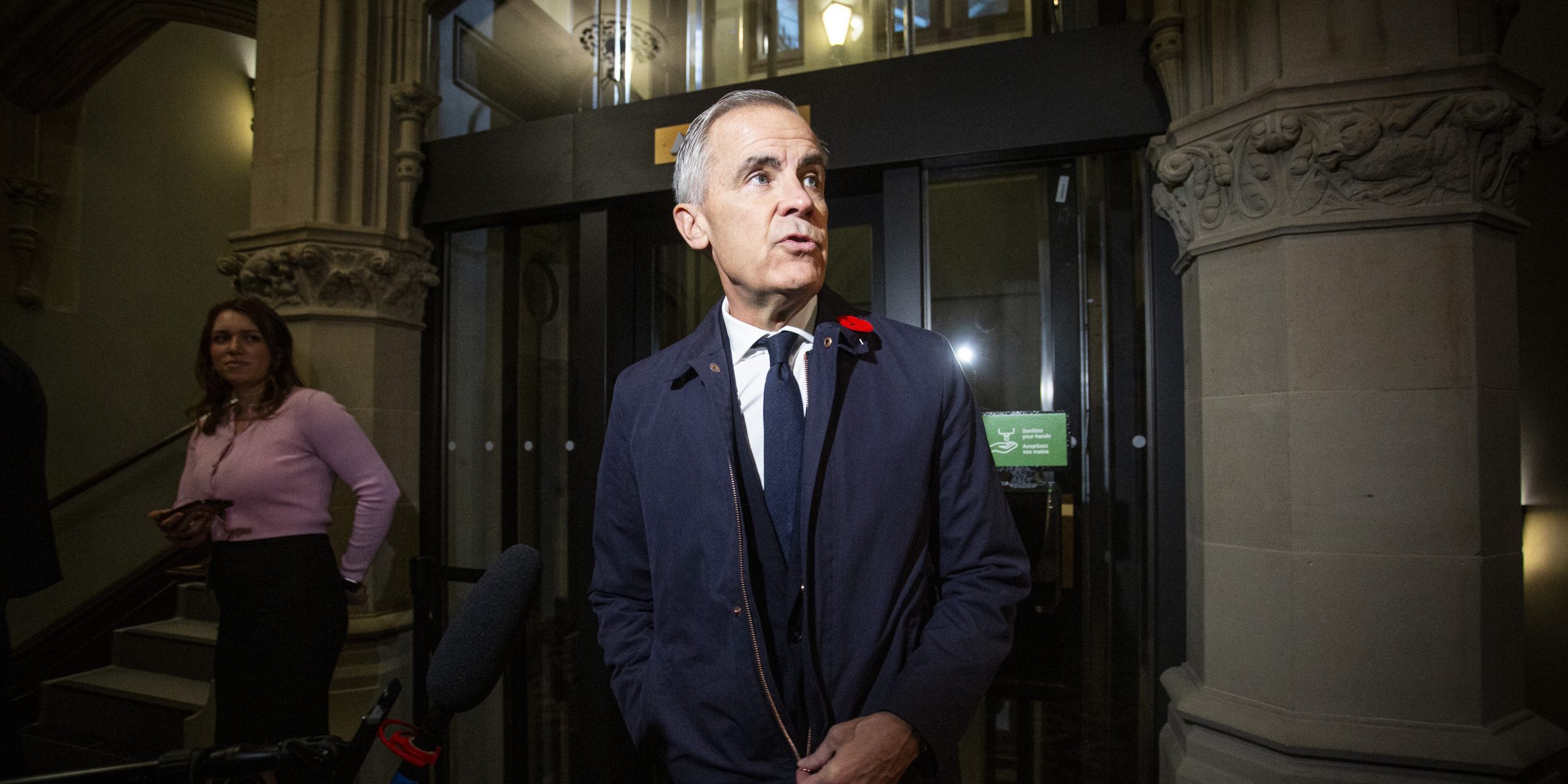
Prime Minister Mark Carney speaks with reporters before the Liberal cabinet meeting in West Block on Oct. 27, 2026. The Hill Times photograph by Andrew Meade
Quebecor’s bid to acquire Telus faces an uphill battle—but Ottawa isn’t shutting the door
Regulatory | |November 18, 2026
Opposition MPs, financial analysts, and competition hawks are calling on Ottawa to reject Quebecor Inc.’s $31-billion attempt to acquire Telus Corp., but the Liberal government hasn’t dismissed the idea.
Announced earlier this week, the proposed transaction would reduce the number of national telecom carriers from four to three, and give Quebec billionaire Pierre Karl Péladeau control over the western Canadian telco that, alongside BCE Inc. and Rogers Communications Inc., comprises Canada’s ‘Big Three.’
Peladeau has framed the acquisition as a boon for Canadian sovereignty in a critical infrastructure sector vulnerable to foreign actors, including Space Exploration Technologies Corp.’s (SpaceX) Starlink, owned by Elon Musk. It’s a pitch he likely made in recent meetings with Privy Council clerk Michael Sabia, Industry Minister Mélanie Joly (Ahuntsic-Cartierville, Que.), and Tim Krupa, director of policy for Prime Minister Mark Carney (Nepean, Ont.)
However, critics are worried the deal could drive up internet and cell phone prices for many Canadians already struggling with the cost of living.
In her initial reaction, Joly acknowledged the proposal without passing judgement, and emphasized the need to “prioritize the best interests of Canadians and Canadian sovereignty.”
Meanwhile, speaking to reporters in China on Nov. 18, Prime Minister Mark Carney (Nepean, Ont.) signalled a degree of openness to the purchase, which would ostensibly remove a competitor from an oligopolistic industry.
“It’s about affordable access to telecom services today and in the future,” said Carney, the longtime economist and central banker turned politician. “We have a competition lens, a pro-competition lens, because that’s what’s going to drive affordability for Canadians.”
“Depending on the market structure, the form of oligopoly can lead to more competition with fewer players under certain circumstances. It depends on the market structure aspect of it and we need to take an informed decision on that.”
Carney also said Ottawa is currently updating its telecoms policy because of “technological change [and] potential changes to the market structure.”
In addition to government approvals, the transaction must be independently green lit by the CRTC and the Competition Bureau, both of which could delay the transaction’s close. In fact, arduous regulatory processes, as well as a lengthy court battle, took two years before Rogers’ $26-billion takeover of Shaw was finalized in 2023.
In a statement, CRTC spokesperson Benoit Fortin said the commission as aware of the proposal, and that its role in regulatory reviews is to “ensure that the objectives of the Broadcasting Act continue to be met, and so the reviews focus on any broadcasting assets (television channels, radio stations, and cable and satellite television services).”
Quebecor’s proposal has already spurred public discussion mirroring the contentious battle that played out during the Rogers-Shaw merger, which faced a stiff challenge from ex-competition commissioner Matthew Boswell. Ultimately, the deal was approved by Justin Trudeau’s government, on the condition that Rogers agreed to various labour force and investment commitments, though the effects of the transaction on the consumer bills and job figures are still being debated.
Walking the walk
Some industry observers were surprised by the government’s perspective, given the Liberals have evoked a staunch pro-competition in recent months, especially with regards to the domestic telecoms sector.
Ahead of the recent federal budget, the Liberals unveiled a competition roadmap for the industry that outlined policy measures to add choices for Canadians, improve service quality, and lower costs.
“It was a missed opportunity to build on all that good talk about competition,” said Keldon Bester, executive director of the Canadian Anti-Monopoly Project, in an interview. “This transaction, should it play out fully, is really going to be the test of whether [the government] means it, or whether they’re swayed by these sovereignty and investment arguments.
“The minister’s letter leaves a big question mark over whether we’ll have a united front against this.”
According to lawyer Joshua Krane, who heads competition for MLT Aikins, the government’s approval is contingent on a move away from a long-held policy that favours a telecoms market with four national telecom players.
“But that’s not to say they couldn’t change their policy for this transaction,” Krane told The Wire Report. “Joly didn’t come out totally opposed to this. It wasn’t a hard no. It was a, ‘we’ll think about it.’”
Krane also suggested, if the government supports the acquisition, the Liberals could make legislative amendments to the Competition Act that would facilitate the transaction.
“Ultimately, Parliament has the final say,” he said. “If the Government of Canada felt this was in the national interest, they could enact a rule.”
Since the Rogers-Shaw merger, Parliament has passed multiple bills overhauling competition law, including Bill C-56, which received Royal Assent in 2023. Among other things, C-56 removed the “efficiency defence,” which allowed otherwise anti-competitive mergers to proceed as long as they demonstrated commensurate efficiency gains. Although the Competition Tribunal did not rule on the validity of the efficiencies defence in the Rogers-Shaw case, the exception was repeatedly raised throughout the proceedings.
NDP leads push to block deal
Perhaps NDP Leader Avi Lewis has been the most vocal critic of the proposed takeover in the days following the announcement.
On Nov. 18, Lewis held a press conference outside Quebecor’s headquarters in Montreal to advocate for the takeover bid to be squashed. The telco’s headquarters are located in the riding of Laurier—Sainte-Marie, previously held by Trudeau-era cabinet minister Steven Guilbeault, where a byelection is set to be held next month.
“Canada already has some of the most expensive phone plans in the world,” Lewis wrote on Facebook. “We should be breaking up the telecom monopolies, not adding another. The Competition Bureau must block this sale.”
The NDP leader also responded to Carney’s suggestion that more concentrated oligopolies can create increased competition under certain conditions, as Lewis described it as a myth “politicians tell when they’re more interested in protecting corporate power than delivering affordable services to Canadians.”
“Canadians see right through this,” he wrote.

The attempted takeover has also featured during Question Period in the House of Commons, where NDP MP Jenny Kwan (Vancouver East, B.C.) was cheered on by Conservative parliamentarians when she asked the government to block the deal.
“This takeover would further concentrate market power, leaving Canadians with fewer choices, higher phone bills, and job losses,” said Kwan on Nov. 17.
“Canadians need more competition, lower prices, and stronger public interest protections, not further corporate consolidation.”
In response, Liberal MP Carlos Leitão (Marc-Aurèle-Fortin, Que.), who serves as Joly’s parliamentary secretary, noted the two parties have yet to actually finalize a deal, but any agreement will still be subjected to various approvals.
“If it’s in the national interest, it will go, but the regulatory process is independent,” said Leitão.
Conservative MPs have been less vocal in their opposition, as Tory MP John Brassard (Barrie South-Innisfil, Ont.) told reporters that competition “has always been good for Canada.”
Brassard’s caucus colleague Sandra Cobena (Newmarket-Aurora, Ont.) added that Conservatives are looking for competition to be “maintained.”
“Prices and the level of service that Canadians would ultimately benefit from are what they need,” said Cobena.
Quebecor could have leverage over feds: Bester
Despite economic and political powerbrokers weighing in on the potential impact of Quebecor’s proposal, there remain several unanswered questions regarding the path forward.
Perhaps most notably, Telus has yet to accept Quebecor’s offer — and they’ve indicated the terms of the current deal are unfavourable.
Telus chair John Manley, former deputy prime minister under Jean Chrétien, said the company had appointed a special committee to independently review the proposal, which has already identified “a number of significant risks…, including the fact that more than four months after its initial proposal, Québecor has yet to explain how what it is proposing could be approved under the current telecom regulatory framework in Canada and that a regulatory review of such a transaction would be a long and costly process for our shareholders.”
According to the Canadian Anti-Monopoly Project’s Bester, the Rogers-Shaw merger involved two willing corporate participants and still incurred massive obstacles, meaning Quebecor’s potentially hostile takeover could face an even more difficult path forward.
Additionally, continued Bester, Quebecor’s status as a disruptive national carrier could become a source of leverage that squeezes Ottawa into supporting the deal.
Quebecor’s emergence as a fourth nationwide provider in the telecoms market, which has been aided by the CRTC’s wholesale decision allowing telcos to resell services using other companies’ infrastructure, has been touted by industry leaders and public officials as representative of the healthy competition present within the domestic sector.
“Quebecor has done a good job disrupting the market in recent years,” Bester told The Wire Report. “[But] I think we’re now going to see that used as a bit of a cudgel, where they say, ‘either give us this deal, or we’ll pull out of these markets that we’ve been competing in.’”
Meanwhile, Bester said he has the “most faith” in the Competition Bureau, but the independent regulator could be hamstrung by the vacancy at the top of the organization. Despite Boswell’s decision to step away from the commissioner role last December, a successor has yet to be named by cabinet, as Jeanne Pratt has been serving in the top job on an interim basis for nearly a year.
The next permanent commissioner must be appointed by March, and Bester said the Quebecor-Telus affair could be an opportunity for the forthcoming leader to “prove themselves.”
“This should be an audition for [Pratt] as commissioner, and whether or not she’s up to the task for this,” he said.
For Krane, Carney’s choice for competition commissioner could signal the government’s overarching view towards the telecoms market and, more specifically, the Quebecor bid.
“It will depend on who the commissioner is, and the relationship that commissioner has with the government and the industry minister,” he said.
Krane and financial analysts also theorized whether Quebecor’s announcement could open up a bidding war for Telus amongst Canada’s major telcos.
“I would imagine with Telus in play, Bell is going to put in a bid, and maybe Rogers too,” the lawyer said. “You’re going to have companies that are going to bid for this thing to run up the price.”
Elsewhere, in a note, National Bank analyst Adam Shine asked whether Bell could be better-positioned to pursue Telus, given the latter’s debt position and falling stock price.
“BCE [Inc.] also made a move to buy Shaw. Could it show an interest in Telus also?,” wrote Shine. “That would create national telco and wireless against Rogers as national cableco and wireless.”
“[But] it would be a non-starter for Ottawa.”
With files from Paul Park